
Kalimantan and Indonesia’s coastal regions are experiencing unprecedented acceleration in infrastructure development. However, beneath these economic opportunities lies a geotechnical challenge often underestimated by project owners: poor subgrade conditions. Soft soil improvement is a crucial step that must not be skipped in any construction project located in wetlands, swamps, or reclamation areas. Without proper treatment, infrastructure projects—whether toll roads, ports, or industrial facilities—face the risk of fatal structural failure due to uncontrolled soil settlement.
As geotechnical contractors and practitioners at PT Pelita Isiana Pratama, we frequently encounter projects suffering from massive cost overruns simply because they attempted to “save” initial costs by skipping the soil improvement phase. This article will technically dissect why soft soils, particularly in the Kalimantan region, require special treatment, and how the Prefabricated Vertical Drain (PVD) method combined with Preloading serves as the most logically technical and economical solution.
Building on top of soft soil or peat soil without adequate geotechnical engineering is akin to building a castle on a wet sponge. Visually, the surface might appear solid after land clearing, but the mechanical behavior of the soil beneath tells a different story.
Soils in the Kalimantan region, especially coastal and swamp areas, are dominated by soft clay and peat. The primary characteristics of these soil types are very high water content and very low permeability.
Microscopically, soft clay soil structures have a large void ratio. These voids are completely filled with water. When a structural load is placed on top, this trapped water initially supports the load (excess pore water pressure). The main issue is that this water is extremely difficult to expel due to the tightly packed, fine-grain nature of the clay.
Meanwhile, peat soil reinforcement presents its own unique challenges. Peat is organic material that has not fully decomposed. It possesses extreme compressibility properties—it can shrink by up to 50% or more from its original thickness when loaded. Furthermore, peat undergoes biological decomposition over time, causing secondary consolidation settlement that continues for decades. Without engineering intervention, the bearing capacity of this soil for heavy structural loads often approaches zero.
The greatest risk with soft soil is not sudden collapse (although that can occur), but rather consolidation settlement.
Consolidation is the process of water being expelled from soil pores due to loading, causing soil grains to densify and soil volume to shrink. In sandy soils, this process is instantaneous. However, in Kalimantan’s soft clay soils, this process can take years, or even decades.
Imagine you own a logistics warehouse or a highway. If the soil beneath it settles 50 cm over 5 years, but the settlement is nonuniform (differential settlement), the structure above will crack, tilt, or even fracture. We often see this phenomenon on roads in swamp areas that become severely “wavy” despite having just been repaved.
For project owners, ignoring soil improvement is often viewed as a CAPEX (Capital Expenditure) saving. However, field data shows the opposite. Post-construction remedial costs due to foundation failure can reach 3 to 5 times the cost of the soil improvement that should have been done initially.
The impacts include:
High Maintenance Costs: Repeated road patching or floor re-levelling in warehouses.
Operational Disruption: Facility closures for emergency repairs.
Asset Damage: Precision machinery structures (such as conveyor belts or turbines) are highly sensitive to foundation tilting.
Therefore, investment in soil improvement is not merely a cost, but a technical insurance policy for the sustainability of your assets.
In modern geotechnical engineering, we don’t have to fight nature, but engineer it. One of the most effective and globally proven soil improvement techniques is the Preloading method assisted by PVD (Prefabricated Vertical Drain).
PVD is a long, ribbon-shaped geosynthetic composite material inserted vertically into soft soil. PVD consists of two main components:
Core: Made of profiled polypropylene (like fins) which functions as a channel for water flow.
Filter Jacket: Made of non-woven geotextile wrapping the core, functioning to filter soil particles so they do not clog the water flow, while still allowing water to enter.
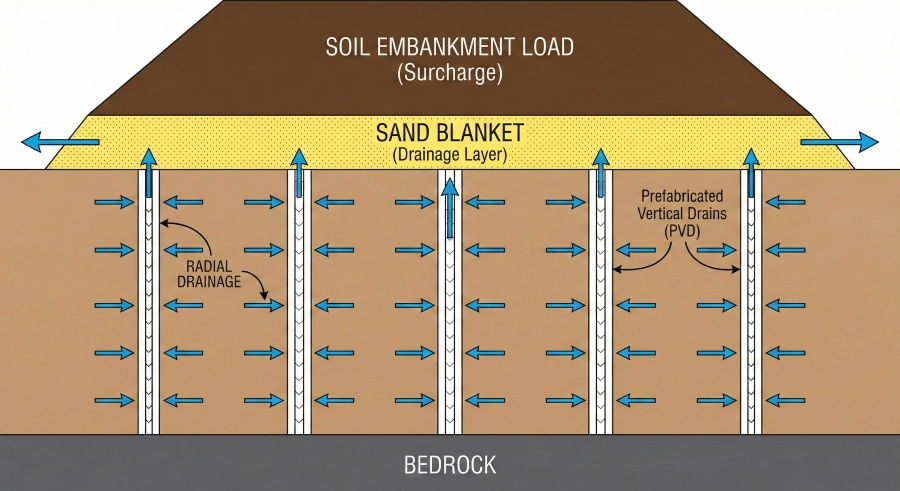
You can imagine PVD as giant “straws” inserted into the soil to help squeeze water out of the clay “sponge.”
Technical Note: The quality of PVD material is crucial. International standards like ASTM D4595 are often used as references for the tensile properties of the geosynthetic materials used, ensuring the PVD does not snap during installation or during soil movement.
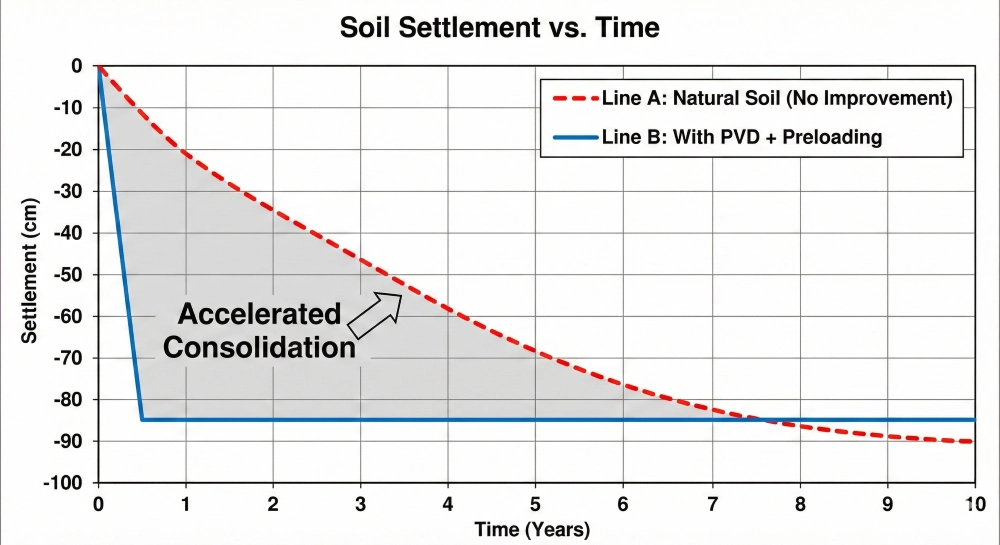
This is where the “magic” of geotechnical engineering lies. PVD does not work alone; it requires a load to press the water out. This method is called Preloading or applying an initial load (usually in the form of a soil embankment) that is heavier than the planned structural load to be built later.
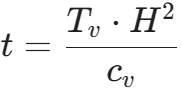
The mechanism can be explained through Terzaghi’s consolidation theory. The time required to reach a certain degree of consolidation (t) is directly proportional to the square of the drainage path distance (H2) and inversely proportional to the coefficient of consolidation (cv).
Without PVD, water must flow vertically to the soil surface to escape. If the soft soil layer is 20 meters thick, water from the bottom must travel 20 meters.
With PVD installation spaced closely (e.g., every 1 meter), the water flow pattern changes from vertical flow to radial (horizontal) flow towards the nearest PVD. The water drainage path is drastically reduced from 20 meters to only about 0.5 – 0.7 meters.
The consequence? The settlement process that naturally takes 10-15 years can be accelerated to just 3-6 months. The soil is forced to “settle” and densify before building construction begins. Once the soil is stable, the embankment load is removed, and the soil is ready to receive construction loads without the risk of excessive settlement in the future.
Clients often ask, “Why not just use spun piles down to the hard soil?”
The answer lies in function and cost.
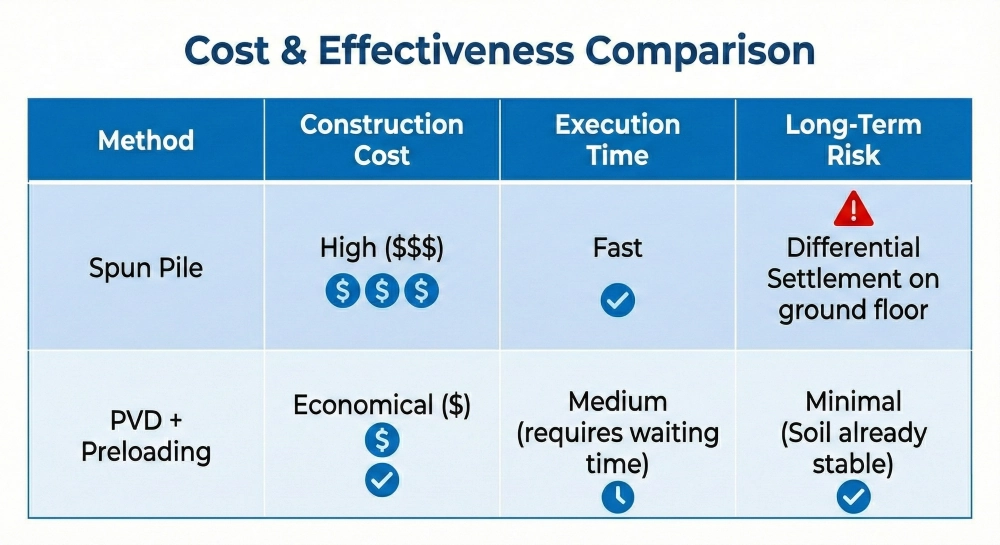
Deep Foundation (Spun Pile): Transfers structural load directly to hard soil at depth. This is effective for supporting buildings, but it does not prevent the surrounding soil from settling. As a result, the ground floor (slab on grade) can sink separately from the building columns, or access roads leading to the building become “depressed.”
PVD + Preloading: Improves the characteristics of the soil itself. The soil becomes denser, its shear strength increases, and settlement risk is minimized comprehensively across the entire area.
From a cost perspective, for large areas such as ports, toll roads, or industrial estates, the use of PVD is far more economical (potentially saving up to 40-60%) compared to piling across the entire floor slab area.
As an experienced contractor, PT Pelita Isiana Pratama executes rigorous field procedures to ensure the swamp soil foundation solutions we offer are successful.
Before heavy equipment enters, the work area is usually still soft swamp. The first step is laying a Geotextile Separator over the original soil. This layer prevents the fill material from mixing with the mud underneath.
On top of the geotextile, we spread a Sand Blanket (sand layer) 30-50 cm thick. This sand blanket has two vital functions:
As a working platform to allow heavy equipment (PVD Rigs) to move.
As horizontal drainage. Water rising through the PVD will flow into this sand layer, and then be discharged into side trenches.
The installation process is carried out using specialized PVD Rigs equipped with a mandrel (steel sleeve) to insert the PVD ribbon to the planned depth (which can reach 20-30 meters).
However, the key to success lies not just in installation, but in Monitoring. During the soil preloading process, we install geotechnical instruments:
Settlement Plate: To measure how deep the soil has settled.
Piezometer: To monitor pore water pressure.
Inclinometer: To detect lateral soil movement (landslides).
Data from these instruments is analyzed by our engineering team to verify if the consolidation target (e.g., 90%) has been achieved. This practice aligns with guidelines often referenced in publications by the Indonesian Society for Geotechnical Engineering (HATTI).
Choosing a partner in the geotechnical field requires trust and proof of competence. PT Pelita Isiana Pratama positions itself not just as a vendor, but as a strategic partner for your project’s success.
We understand that the soil in Kalimantan is different from soil in Java or Sumatra. Our experience handling projects in swamp and peat terrains gives us local technical wisdom that general contractors do not possess. We understand the nuances of logistics for sand material in the interior of Kalimantan to extreme weather challenges.
One of the biggest obstacles in infrastructure projects is equipment mobilization. As an Indonesian PVD contractor focused on this region, we have a fleet of PVD Rigs ready to be mobilized quickly. The availability of geosynthetic material stock (PVD, Geotextile, Geomembrane) also ensures your project will not stall waiting for imported shipments.
With a combination of senior technical expertise, complete equipment, and deep understanding of local soil conditions, PT Pelita Isiana Pratama is ready to transform risky swamp land into a solid foundation for your investment.
Don’t let the risk of soft soil haunt the future of your infrastructure. Would you like us to conduct a preliminary assessment of your project’s soil data to determine estimated cost efficiency using the PVD method?
Contact our engineering team today for further technical consultation.
Don’t let technical risks and challenging terrain hinder your investment. Discuss your project needs with the expert team at PT Pelita Isiana Pratama. From geotechnical surveys and land preparation to jetty construction and supporting facilities for the new capital city (IKN), we are ready to provide solutions that are Precise, Efficient, and Compliant with SNI Standards.
Butuh bantuan? Tim kami siap membantu.