
In the industrial investment landscape of Indonesia, particularly in resource-rich Kalimantan, Civil Works for Palm Oil Mills and mineral refining facilities (smelters) play a vital role often underestimated during initial planning. For Downstreaming Investors and Technical Directors of plantation groups, production efficiency isn’t just about selecting the best brand of Thresher or Furnace. More fundamentally, operational continuity depends entirely on what lies beneath those machines: the foundation.
As a contractor long-established in the challenging terrain of Kalimantan, PT Pelita Isiana Pratama (PIP) frequently encounters structural failures caused by fatal errors in understanding load characteristics. Many general contractors treat industrial machine foundations the same as office building column foundations. In reality, the field conditions are vastly different. This article technically dissects why machine foundations require precise engineering approaches, the risks of dynamic loads, and the construction standards we implement to guarantee the longevity of your investment.
Building industrial facilities in Kalimantan presents a dual challenge: soft soil conditions (peat or swampland) and extreme operational load demands. Failure to anticipate these challenges results not only in cracked floors but can lead to catastrophic failure where machines detach from their mounts, causing months of production downtime.
In civil engineering, a fundamental understanding of load types is key to structural safety. In standard commercial building construction, engineers focus on Static Loads. These are dead loads (the structure’s own weight) and live loads (people/furniture) that act vertically due to gravity and tend to be constant over time.
However, in the context of civil works for palm oil mills or smelters, the primary enemy is Dynamic Load. These loads are generated by moving machinery, whether rotating motion like turbines and electric motors, or reciprocating motion like giant diesel gensets or compressors.
The characteristics of dynamic loads are far more complex, involving:
Varying Magnitude: Load magnitudes that change rapidly within seconds.
Fatigue (Material Fatigue): Concrete and reinforcing steel subjected to repetitive stress will experience strength degradation much faster than under static loads.
Horizontal & Torsional Forces: Machines do not just press downward; they also exert sideways thrust and twisting forces (torque) during start-up or shutdown.
If your contractor calculates soil bearing capacity based solely on the machine’s dead weight (kg) without accounting for these dynamic factors, the foundation is almost certain to fail in a short time.
This is the physics concept most often ignored yet most deadly to industrial structures. Every object has a Natural Frequency, including concrete foundation structures. Conversely, every operating machine has an Operating Frequency.
Disaster strikes when the machine’s Operating Frequency ($f_o$) approaches or equals the foundation’s Natural Frequency ($f_n$). This phenomenon is called Resonance.
Engineer’s Note: When resonance occurs, vibration amplitude increases exponentially. Small vibrations from the machine are “multiplied” by the foundation, creating violent shaking that can shear anchor bolts, crack concrete blocks, and even damage the internal components of your precision machinery.
PT Pelita Isiana Pratama implements strict design standards referenced from ACI 351.3R (Foundations for Dynamic Equipment). We ensure the frequency ratio (fo / fn) is far from the resonance zone (typically designed so fn is at least 20-30% higher or lower than fo). Without this vibration analysis, palm oil mill construction is simply waiting for major repairs.
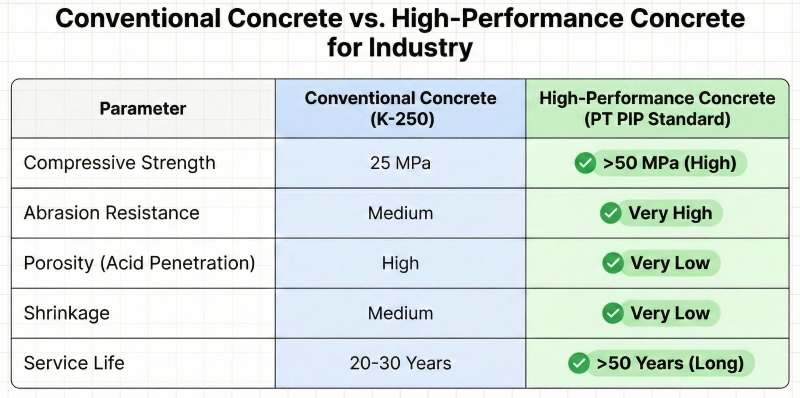
Beyond physical loads, chemical challenges in factory areas cannot be overlooked.
Palm Oil Mills (POM): Sterilizer station areas and waste treatment sections are highly vulnerable to exposure to fatty acids and corrosive steam. Standard concrete with high porosity is easily penetrated by acidic substances, triggering rust on the internal steel reinforcement.
Smelters: Smelting furnace areas radiate extreme heat that can cause dehydration in concrete, making it brittle and prone to spalling.
Therefore, in every industrial machine foundation project, PT PIP does not just use standard grade concrete. We formulate special mix designs with additives to increase concrete density and resistance to sulfate attack or heat, in accordance with SNI 2847:2019 concerning Structural Concrete Requirements.
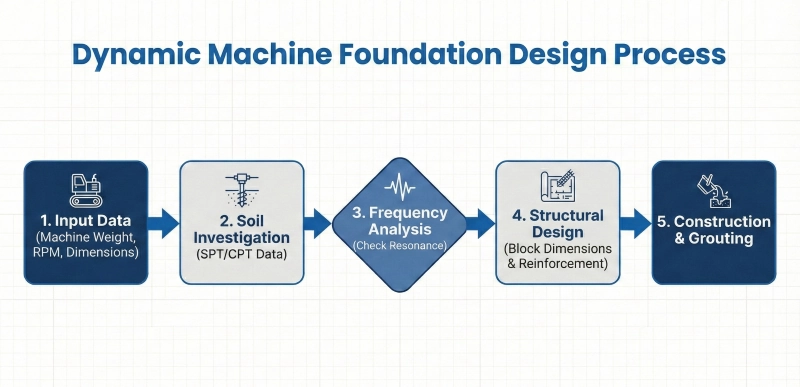
Building foundations for Ball Mills, Crushers, or Steam Turbines requires integrated Geotechnical and Structural engineering disciplines. The following are the technical standards PT Pelita Isiana Pratama applies in every EPC project.
The most effective solution for handling heavy machine dynamic loads is applying Mass Concrete or massive block foundations. The principle is simple yet crucial: inertia. The heavier the foundation mass, the harder it is for machine vibration forces to move it.
As a rule of thumb in engineering standards, the foundation weight must be at least 3 to 5 times the weight of the machine it supports. However, weight alone is not enough. The reinforced concrete structure design of the foundation block must have sufficient stiffness to prevent deformation.
We implement dense reinforcement configurations not just to withstand tensile loads, but also to “confine” the concrete so it remains solid when subjected to continuous vibration. The use of deformed bars with steel grade BJTS 420 (approx. 420 MPa yield strength) or higher is our mandatory standard to ensure a strong bond between concrete and reinforcement.
One of the biggest mistakes in palm oil mill EPC contractor projects is relying on assumed soil data or old data from different locations. In Kalimantan, soil conditions can change drastically within just 50 meters. Peat, soft clay, or loose sand exhibit poor dynamic behavior as they can undergo liquefaction or excessive settlement when vibrated.
PT PIP mandates comprehensive Soil Investigation before design begins, including:
Standard Penetration Test (SPT): To determine hard soil bearing capacity.
Cone Penetration Test (CPT/Sondir): To map the soil layer profile.
Laboratory Tests: To determine dynamic soil parameters (Dynamic Shear Modulus).
We use this data to calculate the soil spring constant. If the native soil is deemed unfit to withstand vibration, we will recommend soil improvement or the use of spun pile foundations reaching hard soil layers to guarantee long-term machine stability.
After the concrete foundation is poured and reaches maturity (usually 28 days), the machine is not placed directly on top of the concrete. There is a vital intermediate layer called Grouting.
Many inexperienced contractors use ordinary cement mortar to fill the gap between the machine baseplate and the foundation. This is a fatal error. Ordinary cement shrinks as it dries, creating air voids. Consequently, the machine does not sit perfectly, causing excessive vibration and bearing damage.
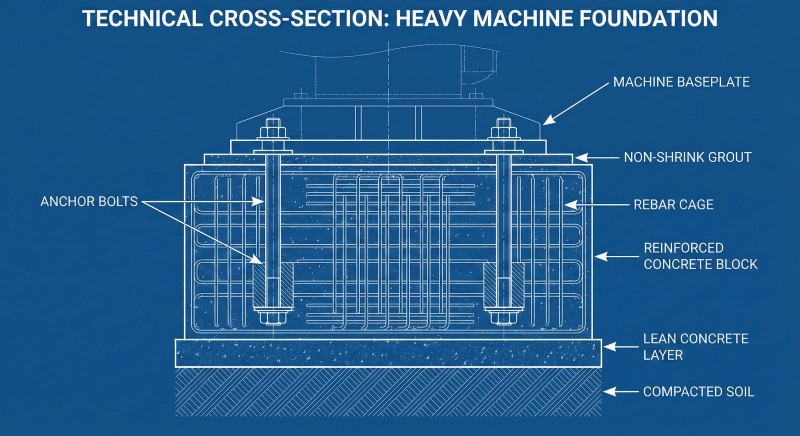
PT Pelita Isiana Pratama uses only high-performance Non-Shrink Grout or Epoxy Grout materials. These materials possess properties of:
High Flowability: Capable of flowing to fill the tiniest gaps under the machine.
High Early Strength: Hardens quickly so machines can be installed immediately.
Dynamic Load Resistance: Withstands repetitive shocks without cracking.
The grouting pouring technique also requires special expertise to avoid air entrapment which can weaken the machine mount.
A factory consists of more than just main machinery. The surrounding ecosystem, from production floors to warehouses, must have equivalent specifications to support heavy equipment mobility.
Factory floors (slabs) in POM or Smelter areas endure daily torture from the maneuvering of Forklifts, Wheel Loaders, and logistics trucks. Cracked or uneven floors are not only disruptive but jeopardize work safety and accelerate heavy equipment tire damage.
For these areas, our technical specifications include:
Concrete Grade: Minimum K-350 to K-500 (approx. 30-45 MPa), depending on vehicle axle loads.
Reinforcement: Use of double layer wiremesh or steel fiber reinforcement to increase resistance to tensile cracking.
Floor Hardener: Application of metallic or non-metallic hardener on the concrete surface during finishing. This creates a surface that is extremely hard, abrasion-resistant, and dust-free.
Joint Sealant: Creation of expansion joints and contraction joints filled with polyurethane sealant to accommodate concrete expansion and contraction without causing wild cracks.
As part of integrated civil works for palm oil mill services, PT PIP is also expert in the fabrication and erection of steel structures for warehouses and workshops. Given factory locations often in high rainfall and strong wind areas, we use AISC (American Institute of Steel Construction) steel design standards.
Our focus on steel structures includes:
Bolted Connections: Using High-Strength Bolts (HTB – A325) tightened with a measured torque wrench, more reliable than field welding whose quality is difficult to control.
Corrosion Protection: Sandblasting application to Sa 2.5 cleanliness level, followed by high-quality epoxy primer and top coat for maximum corrosion resistance in humid tropical environments.
Choosing a construction partner is a strategic decision. PT Pelita Isiana Pratama offers a combination of deep technical expertise and unmatched field mastery.
We understand that Smelter and POM projects are under high scrutiny regarding environmental issues. In executing industrial machine foundations, we implement work methods that minimize construction waste and keep the site tidy (5S). More importantly, our team is certified in Construction HSE, understanding risks of working at heights, confined spaces, and high-voltage areas. Zero Accident is not just a slogan, but our primary KPI in every project.
Logistical challenges in Kalimantan often cause project delays due to late equipment or labor. PT PIP has competitive advantages in the form of:
Local Workshops: Accelerating fabrication of steel components and formwork.
Heavy Equipment Fleet: Excavators, Cranes, to Concrete Pumps owned by us or trusted partners, ensuring equipment availability when needed.
Expert Team: From experienced Structural Engineers, Geotechnical Engineers, to Surveyors ready to deploy to even remote locations.
Building a Palm Oil Mill or Smelter is a long-term investment worth trillions of rupiah. Do not let this investment be threatened simply due to cost-cutting on foundation structures. The risk of machine damage due to undamped vibration is far more expensive than the cost of building the foundation correctly from the start.
PT Pelita Isiana Pratama is ready to be your strategic partner, translating operational machine needs into solid, precise, and durable concrete structures. We don’t just build buildings; we build certainty for your business operations.
Are you ready to discuss your industrial facility construction plans? Contact our expert team today for an initial technical consultation and site survey.
Don’t let technical risks and challenging terrain hinder your investment. Discuss your project needs with the expert team at PT Pelita Isiana Pratama. From geotechnical surveys and land preparation to jetty construction and supporting facilities for the new capital city (IKN), we are ready to provide solutions that are Precise, Efficient, and Compliant with SNI Standards.
Butuh bantuan? Tim kami siap membantu.