
Kalimantan is the heart of Indonesia’s energy sector, where the economic lifelines of coal and Crude Palm Oil (CPO) rely heavily on river transportation routes. However, for mine concession holders and plantation owners, building logistics infrastructure in this region is no simple task. Soft soil conditions, high sedimentation rates, and extreme tidal ranges demand a high level of technical expertise. As an experienced Kalimantan Jetty Contractor handling various port infrastructure projects, PT Pelita Isiana Pratama (PIP) understands that a jetty is not merely a docking space, but a vital asset determining your business throughput and profitability.
Structural failure due to settlement or premature corrosion is not just an issue of repair costs; it has the potential to halt shipping operations for months. This article will technically dissect these challenges and the engineering solutions necessary to ensure your jetty remains robust for decades to come.
The geographical condition of Kalimantan’s waters, particularly in the Mahakam and Barito rivers, extending to the coastal areas of Central and South Kalimantan, possesses unique hydrodynamic profiles. For marine civil works practitioners, understanding the “behavior” of the water and soil in this location is the primary step before designing any structure.
One of the greatest enemies of logistics efficiency in Kalimantan is the high rate of sedimentation. Mud material carried by river currents often causes rapid silting in turning basins and berthing areas.
Technically, this has a direct impact on operations:
Draft Restrictions: A 300ft barge requires a safe minimum draft of 4-5 meters when fully loaded. Silting forces operators to reduce cargo volume (under-capacity) to avoid grounding, which directly erodes profit margins.
Trestle Length Design: To reach adequate natural depths (bathymetric contours), jetties often must be built jutting far out into the middle of the river or sea. This increases structural complexity and construction costs.
As a long-term solution, Hydro-Oceanography analysis must be conducted before piling to predict sedimentation patterns, allowing the jetty head to be positioned at a point that minimizes the need for routine dredging.
Kalimantan waters have significant tidal range characteristics, which can reach elevation differences of 2 to 3.5 meters between Highest Astronomical Tide (HAT) and Lowest Astronomical Tide (LAT).
This condition creates challenges in both new designs and wharf repair projects:
Ramp Door Angle: If using a fixed jetty system, during the lowest ebb tide, the ramp door slope angle can become too steep for dump trucks or loaders to maneuver safely.
Bollard Pull Force: Changes in water elevation alter the angle of ships’ mooring lines. The design of bollards and fenders must account for the variations in vertical and horizontal forces occurring during both highest tides and lowest ebbs so that the structure does not experience material fatigue.
Building on water (especially over mud) requires a vastly different approach than onshore civil construction. Below are the engineering approaches PT PIP applies to ensure structural durability.
The foundation soil at river mouths in Kalimantan is generally dominated by soft clay with very low N-SPT (Standard Penetration Test) values (<10) down to depths of 20-30 meters. The biggest risks in special port construction in this area are structural settlement and negative skin friction.
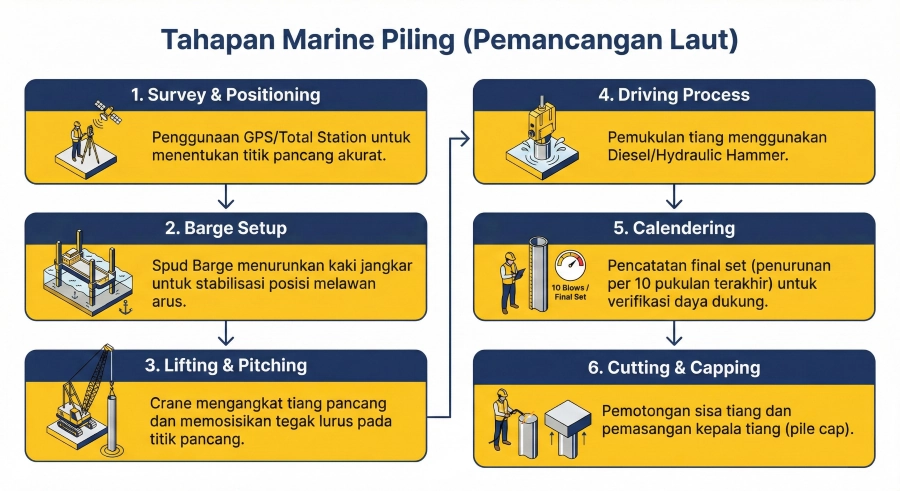
To overcome this, PT PIP implements strict standards in piling:
Pile Selection: We recommend the use of Spun Piles (prestressed concrete) with diameters of 600mm – 1000mm, or Steel Pipe Piles ASTM A252 Grade 2/3, depending on the design load. Steel pipes are often superior for penetration into very deep hard soil layers due to the ease of splicing (welding).
Bearing Capacity Analysis: We do not rely solely on initial soil data. PDA (Pile Driving Analyzer) testing is mandatory to verify actual pile bearing capacity and pile integrity after driving.
Piling Method: The use of Diesel Hammers or Hydraulic Hammers mounted on a Spud Barge (a barge with anchoring legs) ensures precise, perpendicular pile positioning, minimizing load eccentricity that could damage the structure.
Expert Note: In very soft soils, we calculate for Negative Skin Friction—a condition where settling soil actually adds load to the pile rather than supporting it. Ignoring this factor is a leading cause of many jetties “sinking” within 5 years.
Many mine owners ask about the comparison of barge jetty construction costs (floating/pontoon systems) versus permanent wharves (concrete trestles). This choice depends on logistics volume and river characteristics.
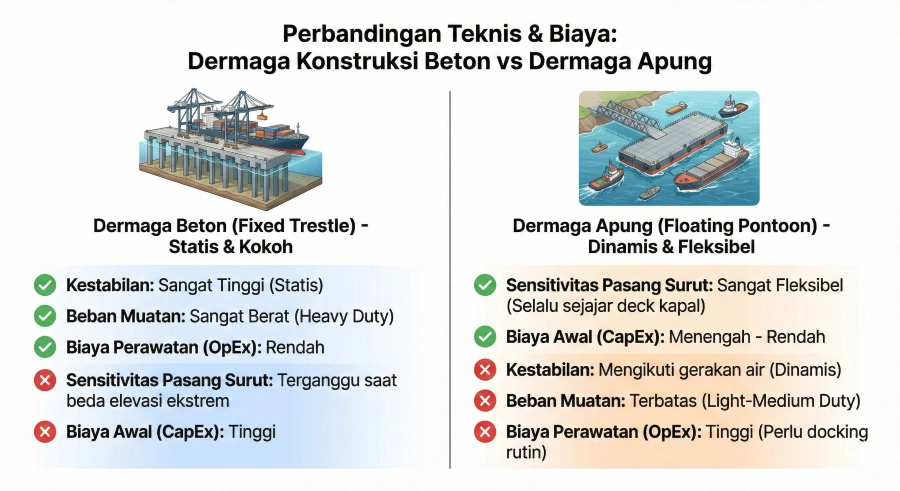
For high-intensity operations (24 hours nonstop) using large heavy equipment, a Fixed Trestle structure combined with a Movable Bridge is often the best hybrid solution to accommodate tides without sacrificing stability.
| Feature | Concrete Wharf (Fixed Trestle) | Floating Dock (Floating Pontoon) |
| Stability | Very High (Static) | Follows water movement (Dynamic) |
| Load Capacity | Very Heavy (Heavy Duty) | Limited (Light-Medium Duty) |
| Tidal Sensitivity | Operations disrupted during extreme tidal ranges | Very Flexible (Always level with ship deck) |
| Initial Cost (CapEx) | High | Medium – Low |
| Maintenance Cost (OpEx) | Low | High (Requires routine docking) |
The brackish to salty water of Kalimantan rivers contains chlorides that are aggressive towards reinforcing steel. Without protection, wharf maintenance costs will swell due to spalling (concrete breaking away) and the thinning of steel piles.
PT PIP’s corrosion mitigation strategy includes:
High-Performance Marine Concrete: Using high-grade concrete (minimum K-400 or fc’ 35 MPa) with Type V cement (sulfate resistant) and a low water-cement ratio to reduce permeability.
Concrete Cover: Increasing the thickness of the concrete cover to 70mm – 100mm in the splash zone to slow down chloride penetration.
Cathodic Protection (SACP): For steel piles, we install Sacrificial Anodes made of Aluminum-Indium-Zinc. These anodes will “sacrifice” themselves by corroding first to protect the main steel structure.
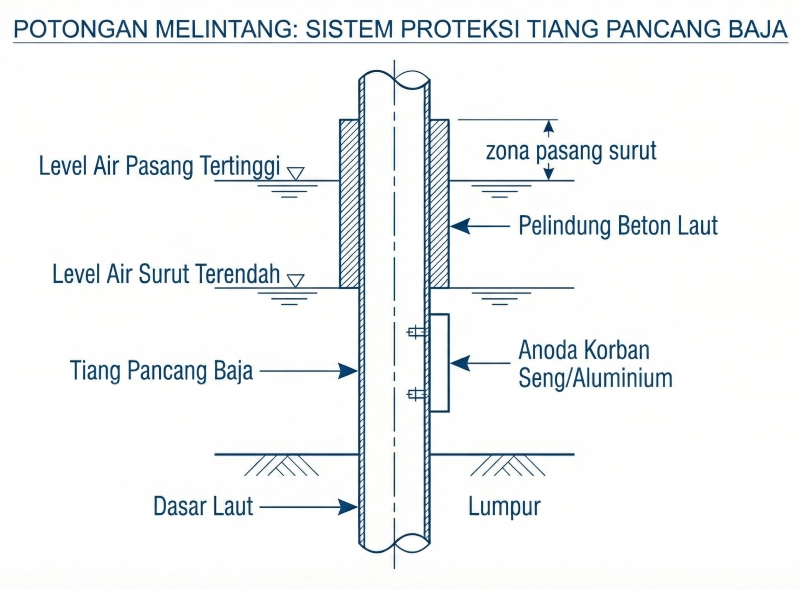
According to international standards like ASTM G52 – Standard Practice for Exposing and Evaluating Metals and Alloys in Surface Seawater, this protection system can extend the service life of steel structures by up to 20 years or more.
Physical construction is only half the equation. As a strategic partner, PT PIP also assists clients in aspects of legality and technical feasibility.
Jetty construction requires environmental documentation (AMDAL or UKL-UPL). This analysis includes the construction’s impact on the river ecosystem and changes in current patterns. An incorrectly designed wharf structure can alter river currents, causing erosion on the opposite riverbank or severe sedimentation in downstream areas. Hydrodynamic model simulations are often necessary to ensure the structure is “friendly” to water flow patterns.
The construction of Terminals for Own Interests (TUKS) is strictly regulated by Minister of Transportation Regulations (such as Permenhub No. PM 20 Year 2017).
Crucial compliance points include:
DLKr & DLKp: Determination of the Port Working Area and Port Interest Area.
Structural Safety: Construction feasibility certification from a certified technical team.
Fender & Mooring System: Must match the largest Deadweight Tonnage (DWT) of the vessel that will berth to prevent damage during berthing.
Choosing a marine civil contractor is not just about the lowest price; it’s about risk mitigation. Project failure in remote Kalimantan areas carries massive logistical cost consequences.
The logistical challenge of mobilizing materials (piles, concrete, steel) to the middle of the Kalimantan jungle is our expertise. We are accustomed to setting up independent site camps, managing supply chains via river, and working in unpredictable tropical weather conditions. Our portfolio includes various coal and CPO TUKS in East and South Kalimantan that are operating at high efficiency.
Do not let poor wharf infrastructure hinder the pace of your commodity business. Investing in the right structure today is a guarantee of future profitability.
Contact the PT Pelita Isiana Pratama engineering team today for an initial technical consultation session and site survey. Let’s build a solid logistics foundation for your business.
Don’t let technical risks and challenging terrain hinder your investment. Discuss your project needs with the expert team at PT Pelita Isiana Pratama. From geotechnical surveys and land preparation to jetty construction and supporting facilities for the new capital city (IKN), we are ready to provide solutions that are Precise, Efficient, and Compliant with SNI Standards.
Butuh bantuan? Tim kami siap membantu.