
Beranda | Landslide Mitigation in Mine Areas and Hauling Roads: The Latest Geotechnical Approaches
In the open-pit mining ecosystem and heavy civil construction sectors of Kalimantan, soil condition uncertainty is the greatest operational enemy. Extreme rainfall and characteristic soft soils often turn mine plans into logistical disasters. The heart of mitigating this risk lies in accurate and comprehensive mine slope stability analysis. Without a deep understanding of soil behavior under the dynamic loads of heavy equipment, mine operations risk not only productivity but also human lives and compliance with strict environmental regulations.
As a practitioner who has been immersed in the geotechnical world for two decades, I often see how slope failure is regarded as “bad luck” due to the weather. In reality, 90% of these events can be predicted and prevented through precise engineering calculations. PT Pelita Isiana Pratama is here to change that paradigm, offering data-driven solutions to ensure the sustainability of your projects in the challenging terrain of Kalimantan.
Slope stability is not merely an administrative requirement in the Work Plan and Budget (RKAB) documents. It is the backbone of an efficient mining sequence. When a mine slope—whether it is a highwall (mining face) or a lowwall (dumping area)—experiences instability, the impact propagates throughout the entire production chain.
A deep understanding of soil mechanics, particularly the interaction between resisting forces and driving forces, is absolute. In Kalimantan, where coal seams are often flanked by water-sensitive mudstone or claystone, margins for error are razor-thin. Therefore, a conservative yet economical approach must be applied in every slope geometry design.
In the geotechnical world, the Factor of Safety (FK) is a sacred number. Simply put, FK is the ratio of the soil’s shear strength holding the slope in place, divided by the shear forces causing the slope to collapse.

However, many field practitioners get trapped by a single number without understanding the context:
FK < 1.0: Unstable condition. Landslide is occurring or imminent.
1.0 < FK < 1.25: Critical condition. The slope may appear stable, but a slight rise in groundwater level or vibration from blasting can trigger a re-run of slope stability analysis showing potential failure.
FK > 1.3 – 1.5: Generally considered safe for long-term permanent slopes.
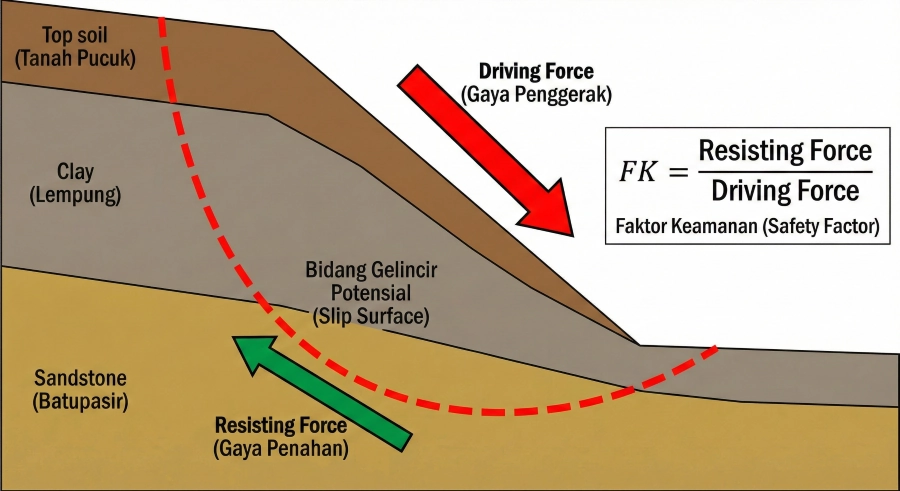
At PT Pelita Isiana Pratama, we don’t just provide a single FK number. We conduct sensitivity analysis to see how the FK changes when soil parameters (such as cohesion or friction angle) degrade due to weathering. This is crucial because material in Kalimantan experiences significant strength reduction after exposure to air and water.
A landslide on a highwall is not just a matter of moving collapsed dirt. It is a financial nightmare. Imagine the following scenario: a main ramp is buried by a landslide volume of 50,000 BCM.
Direct Cost: The cost of re-handling unproductive material.
Opportunity Cost: The halting of the hauling fleet during cleanup, which can consume days to weeks.
Equipment Loss: The potential burial of excavator or dump truck units operating at the toe of the slope.
Furthermore, the Health, Safety, and Environment (HSE/K3) aspect is a non-negotiable priority. Referring to the Decree of the Minister of EMR Number 1827 K/30/MEM/2018 regarding Guidelines for the Implementation of Good Mining Engineering Practices, any landslide event resulting in a fatality or severe equipment damage can lead to a temporary operational shutdown by mine inspectors.
This is where the importance of a proactive landslide handling strategy lies. Not waiting for a landslide to occur before acting, but detecting soil mass movement through monitoring (such as using Slope Stability Radar or Robotic Total Stations) and performing reinforcement before critical limits are exceeded.
Unlike mining in hard rock regions, Kalimantan presents a unique and complex geotechnical “menu.” We often face:
Soft Soil: Soft clay layers with N-SPT values < 10, possessing low bearing capacity.
Peat Land: Organic material with high compressibility. Soil settlement can occur over long periods, damaging hauling road geometry.
Brittle Sedimentary Rock: Sandstone and claystone that easily disintegrate (slaking) when exposed to wet-dry cycles.
These conditions are exacerbated by Kalimantan’s high rainfall (>3000 mm/year). Water is a lubricant for slip surfaces. A rise in pore water pressure within the soil drastically drastically reduces the soil’s effective shear strength. Without a capable drainage system and site-specific geotechnical analysis, slope failure is only a matter of time.
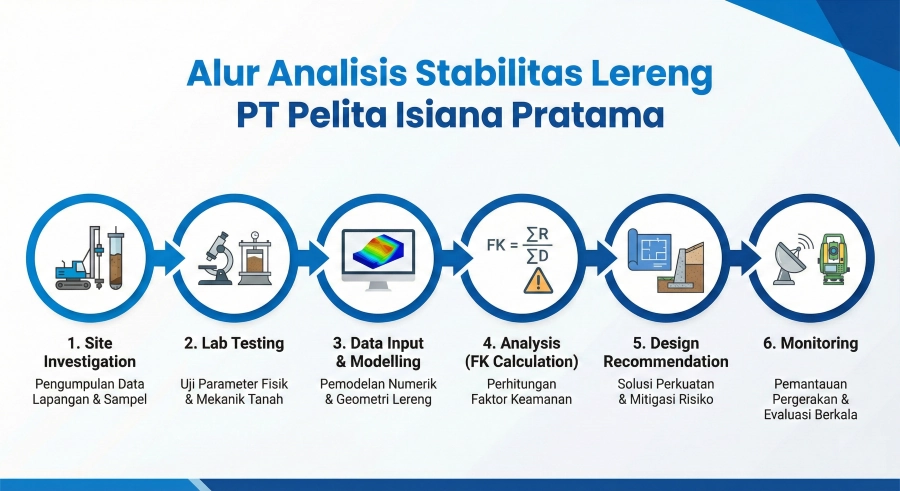
Diagnosing potential slope failure is akin to a doctor diagnosing a disease; it requires advanced tools and expert interpretation. At PT Pelita Isiana Pratama, we combine visual field observations with advanced numerical simulations.
The era of manual calculations using the Fellenius or Bishop slice methods on paper has passed. For modern, complex mine geometry, we utilize software based on the Limit Equilibrium Method (LEM) and Finite Element Method (FEM) such as Slide2, Slope/W, and PLAXIS for more complex cases.
In the slope stability analysis process, we simulate various scenarios:
Dry Condition: During the dry season.
Saturated Condition: Simulating high groundwater levels due to storm rain.
Seismic Load (Pseudo-static): Inputting seismic coefficients according to the Indonesian earthquake map (SNI 1726:2019) to ensure the slope is resistant to tectonic shocks.
The advantage of using FEM over LEM is its ability to predict deformation. We can determine not only if the slope will collapse but also how much soil displacement will occur before total collapse. This information is invaluable for operational teams in determining evacuation thresholds.
No matter how sophisticated the software used, the results will be garbage if the input data is inaccurate (Garbage In, Garbage Out). Key parameters we seek through Soil Investigation are:
Cohesion (c): The binding power between soil particles.
Internal Friction Angle (Φ): Friction between soil grains when receiving a load.
Unit Weight (γ): Weight of material per unit volume.
PT Pelita Isiana Pratama emphasizes the importance of taking undisturbed samples and using accredited laboratory testing. We often encounter cases where other contractors use mere N-SPT correlations to determine parameters c and Φ. Whereas for clay shale material common in coal mines, Triaxial or Direct Shear lab tests are mandatory to obtain realistic residual parameters (residual strength). Using peak strength parameters for long-term design in weathered material is a fatal mistake that often triggers landslides.
After the diagnosis is established and analysis is conducted, the next step is the prescription or technical solution. There is no single cure for all ailments; mitigation methods must be adjusted to constraints of cost, time, and material availability.
Retaining Walls are classic solutions for slope reinforcement where land is limited. For example, in crusher areas or port infrastructure (jetty) where we cannot create gentle sloping due to property boundaries.

There are several types of retaining walls that we recommend based on conditions:
| Retaining Wall Type | Advantages | Disadvantages | Ideal Application |
| Gravity Wall (Masonry) | Cheap, materials easily obtained, simple construction. | Limited to height < 4 meters, heavy self-weight. | Low slopes, drainage channels. |
| Cantilever Wall (Reinforced Concrete) | Suitable for heights 4-8 meters, slimmer, durable. | High cost, requires formwork and concrete curing time. | Permanent infrastructure areas, near workshops. |
| Gabion (Bronjong) | Flexible to follow soil movement, permeable (water can pass through). | Wire can rust (unless PVC coated), less aesthetic shape. | River bank protection, areas prone to water scouring. |
The selection of these types must be based on a cost-benefit analysis. If vast land is available, regrading (making the slope gentler) is much cheaper. However, if space is narrow, a retaining structure is an investment that protects the assets above it.
In dynamic hauling road areas, the use of concrete is often impractical due to the need for long curing times. This is where Geosynthetics technology becomes a game changer. The use of Geotextile (both woven and non-woven) and Geogrid allows us to build steeper yet stable slopes.
The working mechanism is interlocking. Geogrid buried within layers of fill soil acts like steel rebar in concrete; it provides tensile strength that soil lacks. This is highly effective for landslide handling on road bodies located over soft soil.
Additionally, Geotextile functions as a separator. In Kalimantan swampland, if we dump crushed stone directly onto soft soil, the stone will “sink” and mix with the mud. Geotextile prevents this mixing, maintaining the integrity of the road structure so that haul truck cycle times remain optimal because the road is not undulating.
As mentioned previously, water is the main enemy of stability. Adding load (counterweight) or installing sheet piles will not be effective if the water pressure behind the slope is not released.
Our strategy always includes aggressive hydrogeological management:
Surface Drainage: Construction of ditches lined with concrete or shotcrete to prevent rainwater from infiltrating into soil tension cracks.
Sub-surface Drainage: Installation of Horizontal Drain pipes (perforated pipes drilled into the slope) to “drain” groundwater and lower the phreatic line.
In extreme cases, we recommend dewatering using deep wells before excavation is carried out. The principle is simple: Dry soil is stronger than wet soil. Controlling water means controlling risk.
Many consultants can run software, but few understand the “soul” of Kalimantan soil. Textbook theories often must be adapted to muddy field realities and difficult logistics.
PT Pelita Isiana Pratama was born and raised in this challenging environment. We have specific experience in handling peat soil. We understand Pre-loading methods and the use of Prefabricated Vertical Drains (PVD) to accelerate soil consolidation before construction begins. Mistakes in handling peat can cause settlement of up to meters within a few years, a risk we mitigate from day one.
We are not just consultants who deliver thick reports and walk away. We are “Design & Build” partners.
Investigation: Our surveyor and geology teams capture primary data.
Analysis: The engineering team performs stability analysis and reinforcement design.
Execution: Our construction team, complete with heavy equipment, realizes the design in the field.
Data integrity is maintained because there is no handover between different parties. Responsibility rests under one roof. For mine owners, this means efficient communication and clear accountability.
Your mine operational safety depends on the stability of the soil beneath the wheels of your heavy equipment. Do not let geotechnical uncertainty erode company profitability. PT Pelita Isiana Pratama is ready to be your strategic partner in realizing Good Mining Practice through reliable, measurable, and trusted geotechnical engineering.
Next, let’s discuss the specific needs of your site. Contact our expert team for an initial field review.
Don’t let technical risks and challenging terrain hinder your investment. Discuss your project needs with the expert team at PT Pelita Isiana Pratama. From geotechnical surveys and land preparation to jetty construction and supporting facilities for the new capital city (IKN), we are ready to provide solutions that are Precise, Efficient, and Compliant with SNI Standards.
Butuh bantuan? Tim kami siap membantu.