
Constructing commercial infrastructure such as logistics warehouses, factories, or housing estates in East Kalimantan presents unique engineering challenges. Unlike Java, which is dominated by stable volcanic soil, the geological contours in Balikpapan, Samarinda, and the Capital City of Nusantara (IKN) regions often consist of deceptive layers of soft clay, swampland, and peat. For project owners, the most crucial initial decision is not the architectural design, but the validation of soil bearing capacity. This is where Balikpapan CPT Services (Jasa Sondir) become the primary foundation—both literally and figuratively—to ensure your property investment does not sink in the future.
In the world of civil engineering, soil is the most uncertain variable. Concrete strength can be calculated, steel has factory standards, but soil is a heterogeneous natural material. This article will thoroughly explore why accurate geotechnical data is a safeguard for multi-billion rupiah assets and how PT Pelita Isiana Pratama (PT PIP) delivers precise engineering solutions.
East Kalimantan is experiencing a massive surge in infrastructure development. However, this development euphoria often clashes with harsh geotechnical realities. Many strategic areas in Balikpapan and Samarinda sit atop alluvial deposits and ancient swamps. Without comprehensive soil investigation, the risk of structural failure increases exponentially.
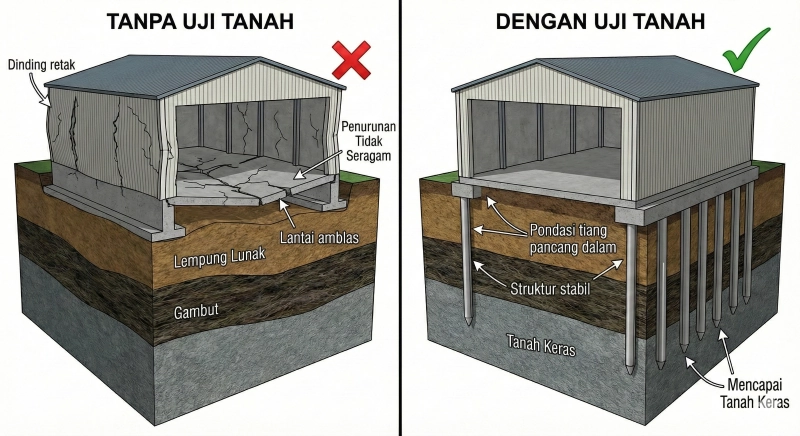
The greatest risk faced by warehouse and factory owners is not the sudden collapse of the building, but what is known as Differential Settlement—or uneven soil subsidence.
Modern warehouses carry very high floor loads due to the use of multi-level racking systems and heavy forklift traffic. If a warehouse is built on soft soil without a foundation that reaches the hard soil layer, the ground beneath will undergo consolidation—compression caused by the expulsion of pore water from soil voids. A fatal problem occurs when one side of the building settles 10 cm, while the other side settles 30 cm.
The impacts include:
Structural Cracks: Walls cracking diagonally or separating from main columns.
Operational Floor Damage: Warehouse floors becoming wavy or fractured, endangering forklift and racking operations.
Building Tilt: The building visibly leans, which is often unfixable without extremely costly underpinning.
Data from the Sondir Test (CPT) provides a cone penetration resistance graph (qc) which serves as the basis for engineers to calculate these settlement predictions before the first pile is driven.
Specifically for the Samarinda region and other low-lying areas, the challenge is compounded by the presence of peat soil. Peat has extremely high water content and extreme compressibility. Often, the hard layer (supporting soil) is only found at depths greater than 20 meters.
Building on this layer without accurate Samarinda soil test services is akin to gambling. Shallow foundations like foot plates (locally known as cakar ayam) are often inadequate to support the load of multi-story buildings or warehouses in this area. Deep foundations (driven piles or bored piles) are required, the depth of which can only be precisely determined through field testing.
PT Pelita Isiana Pratama uses an approach based on SNI and ASTM standards to ensure every piece of data generated is legally and technically accountable.
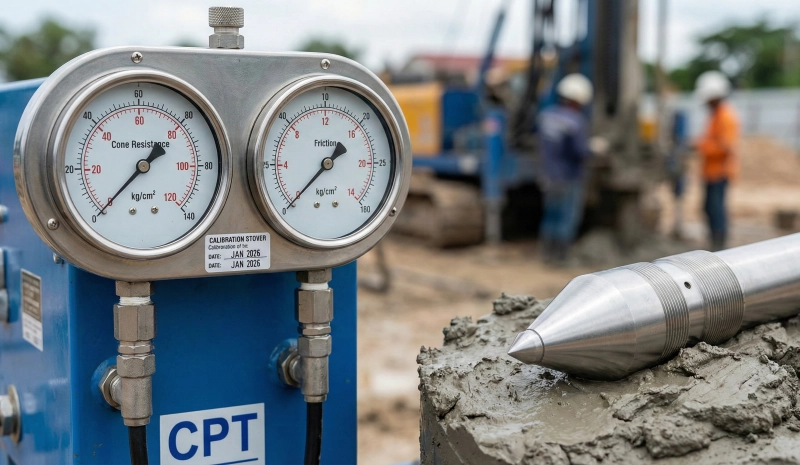
CPT, locally known as Sondir, is the fastest, most economical, and reliable soil testing method for obtaining a continuous profile of soil layering.
Its working principle involves pushing a rod with a cone-shaped tip into the ground at a constant speed of 20 mm/second using a hydraulic or mechanical system. During penetration, the measuring instrument (manometer) reads two main parameters:
Friction Resistance (fs): Measures friction between the cone sleeve and the soil, helping to identify soil type (clay vs. sand) through the Friction Ratio.
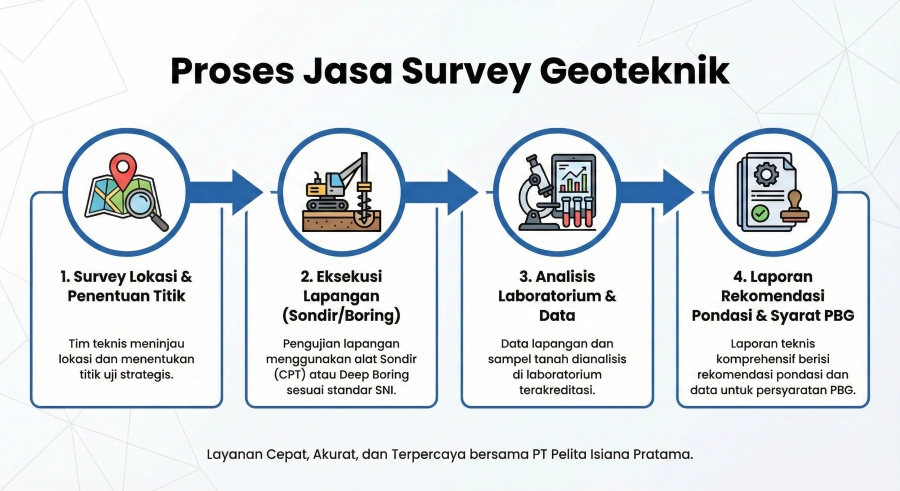
PT PIP adheres to the SNI 2827:2008 standard regarding Field Penetration Testing with Sondir Tools. Adherence to this standard guarantees that the data we produce is valid for use by any structural consultant in Indonesia.
Learn more about national soil testing standards on the official website of the National Standardization Agency (BSN).
Clients often ask, “Do I need Sondir or Boring?” The answer depends on the building load and soil complexity. As an experienced Balikpapan geotechnical consultant, we recommend a combination of both for medium-to-large scale projects.
For warehouse projects, a combination of 3-4 Sondir points and 1 Deep Boring point usually provides the best cost-benefit ratio.
| Feature | Sondir Test (CPT) | Deep Boring (SPT) |
| Data Output | Continuous soil hardness profile. | Undisturbed soil samples & N-SPT values per interval. |
| Advantages | Fast, inexpensive, excellent for detecting soft soil. | Can penetrate very hard soil/rock, visual sampling. |
| Usage | Pile depth determination, shophouses, warehouses. | High-rise buildings (>4 floors), bridges, lab analysis. |
| Limitations | Cannot penetrate rock or dense gravel layers. | Higher cost, longer execution time. |
Many project owners view Kalimantan soil investigation as an “additional cost” that burdens the budget. In reality, from a value engineering perspective, soil testing is the most effective construction cost-saving tool. How so?
Without soil data, structural engineers are obligated to use a very high Safety Factor because they must assume the worst soil conditions. For example, an engineer might design piles to a depth of 24 meters “just to be safe.” However, after a Sondir test, it turns out hard soil is found at a depth of 14 meters. With this data, you can save 10 meters of piling per point. If your building has 60 foundation points, the cost savings could reach hundreds of millions of rupiah—far exceeding the cost of the Sondir service itself.
Conversely, without data, a contractor might assume hard soil is at 6 meters (based on experience at a neighboring project). It turns out, at your specific location, there is a lens of soft soil extending to 12 meters. If foundations are forced to stop at 6 meters, the building will almost certainly experience extreme settlement or collapse. Repair costs for such cases can reach 50-70% of the new building value.
Boring log data provides visual information about soil layers. If swelling clay layers (common in some areas of Kalimantan) are found, engineers can recommend soil improvement or specific foundation types resistant to soil expansion and shrinkage, preventing ceramic floors from cracking in the future.
Since the transition from IMB to PBG (Persetujuan Bangunan Gedung), the government has tightened technical licensing requirements. Soil investigation reports are now mandatory documents that must be attached in the Building Management Information System (SIMBG).
Regional Governments, specifically the Public Works Department (Dinas PU) in Balikpapan and Samarinda, mandate the attachment of soil investigation reports signed by certified geotechnical experts for commercial buildings and multi-story residences. This report must contain:
Testing point map.
Soil profile graphs (Sondir/SPT).
Bearing Capacity recommendations.
Foundation type and dimension recommendations.
Ignoring this stage not only poses technical risks but also hinders the legality of your project. Documents issued by PT PIP are systematically arranged according to the format required by the Ministry of PUPR, thereby smoothing your PBG licensing process.
Amidst many service providers, PT Pelita Isiana Pratama (PT PIP) positions itself as a technical partner, not just a surveyor. Here are the advantages of our services:
Calibrated Equipment and ASTM Standards
We use Sondir machines with capacities ranging from 2.5 tons to 5 tons that are routinely calibrated. The accuracy of manometer readings is non-negotiable for us. We also refer to international standards such as ASTM D3441 (Standard Test Method for Mechanical Cone Penetration Tests of Soil) to ensure data compatibility for multinational clients.
International technical references can be viewed via ASTM International.
Expert Team Experienced in Kalimantan Terrain
Our technicians and engineers have handled hundreds of points across challenging Kalimantan terrain, from wet peatlands to rocky hilly areas. This local understanding allows us to provide more contextual data interpretation, not just numbers on paper.
Fast and Communicative Reporting
We understand that time is money. We can send interim reports immediately after fieldwork is completed so your structural planning team can get to work right away. Our final report is presented in clear technical language, equipped with soil stratigraphy charts that are easy to understand, even for project owners.
Integrated Services
Besides Sondir and boring, PT PIP also provides topography (land surveying) and civil design services. This offers a convenient one-stop solution for those who want to start a project without the hassle of managing multiple vendors.
Building a warehouse, factory, or shophouse in Kalimantan without valid soil data is a dangerous financial speculation. The cost of repairs due to foundation failure is far greater than the initial investment for soil investigation.
By using Balikpapan Sondir Services from PT Pelita Isiana Pratama, you are buying certainty. You get data to optimize construction costs, fulfill PBG legal requirements, and most importantly, ensure the safety of your assets and business in the long term.
Ensure your business foundation stands on data, not guesswork.
Ready to start your project on the right foot? Contact the expert team at PT Pelita Isiana Pratama today for a free consultation regarding soil investigation needs at your location.
Don’t let technical risks and challenging terrain hinder your investment. Discuss your project needs with the expert team at PT Pelita Isiana Pratama. From geotechnical surveys and land preparation to jetty construction and supporting facilities for the new capital city (IKN), we are ready to provide solutions that are Precise, Efficient, and Compliant with SNI Standards.
Butuh bantuan? Tim kami siap membantu.